AI Agent Job Scout
An autonomous AI career agent that searches LinkedIn, scores job fit, and tailors resumes and cover letters — with human-in-the-loop approval and a hybrid semantic matching engine.
Problem
Section titled “Problem”Job searching is a full-time job — except most people already have one.
Every open role means the same manual grind: scan LinkedIn, read a job description, guess which keywords the applicant tracking system wants, tweak the resume (again), write a new cover letter (again), and hope for the best. Multiply that by 20 or 30 applications, and it’s easy to see why so many strong candidates give up early or apply half-heartedly — not because they’re unqualified, but because they’re exhausted.
Meanwhile, the roles that are the right fit often get missed entirely, buried under a flood of listings that don’t match the applicant’s skills, seniority, or goals.
Recruitment has already been transformed by AI on the employer’s side — smart filtering, automated screening, ranked shortlists. Job seekers are still doing this the way we did it in 2005: manually, repetitively, and without any real feedback loop. That imbalance is the opportunity. If AI can help companies find the right candidate faster, it can just as easily help candidates find — and win — the right job faster.
Approach
Section titled “Approach”JobScout is an agentic AI job-search assistant that automates searching, scoring, and tailoring resumes/CVs for job postings with human-in-the-loop approval. It orchestrates multiple LLM-powered modules — resume parsing, tailored content generation, cover-letter writing, semantic matching, and persistent storage — in a repeatable scouting cycle.
What it does NOT do: submit applications on your behalf. It stops at producing ready-to-review files; you apply and track status manually. That boundary was a deliberate design choice, not a missing feature.
The pipeline
Section titled “The pipeline”One run of the agent does, in order:
- Search — pulls open roles from LinkedIn (via a job-board API).
- Skip what’s already been checked — a local record of every job seen before, so the same posting is never re-scored or re-tailored twice.
- Score — compares each new job against a base resume using a hybrid of semantic similarity and skill overlap, producing a 0–100 match score.
- Filter — keeps only jobs above a configurable threshold, sorted best-first.
- Tailor — rewrites the resume for each surviving job: reordering and re-emphasizing real experience to match the role, never inventing skills, employers, or claims that aren’t in the original.
- Write a cover letter — grounded in the same real facts, specific to that job.
- Package — writes a folder per job (job posting, tailored resume, cover letter as polished DOCX/PDF) and adds one row to a tracking spreadsheet you update by hand (status, follow-ups, notes).
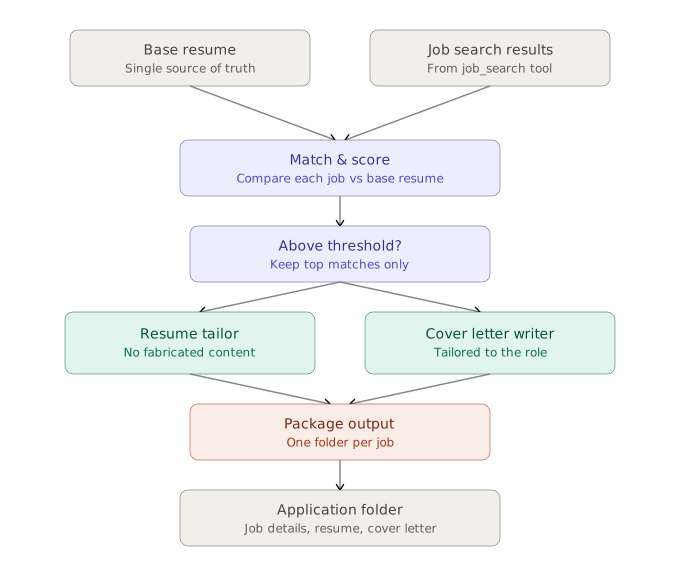
JobScout matching and tailoring pipeline
- For applicants: less time searching, higher-quality applications, better match rates, less burnout
- For the hiring process broadly: candidates show up better prepared and better aligned to the role, which benefits recruiters too
- For the market: a small step toward leveling the playing field between employers’ AI-powered hiring tools and candidates’ still-manual job search
Architecture
Section titled “Architecture”| Layer | Role |
|---|---|
| CLI / Harness | Entry point (run_scouting_cycle) that orchestrates the end-to-end pipeline: parse → search → score → tailor → write → store |
| Matching Engine | Scoring module (semantic + keyword overlap) against a local Chroma vector database |
| Tools | Modular LLM callables — resume_parser, resume_tailor, cover_letter_writer |
| Storage | ChromaDB for persistent job embeddings + seen-URL deduplication; CSV / Excel exports; SQLite metadata cache (via Langfuse telemetry) |
| External Services | OpenAI-compatible LLM API, Ollama (local nomic-embed-text), Langfuse (telemetry), custom Parse API (PARSE_API_KEY) |
High-level architecture
Section titled “High-level architecture”graph TB
subgraph USERS["Users"]
CLI["CLI / python -m src.harness.run_cycle"]
WEB["Static Dashboard<br/>dashboard.html + data.js"]
AGENT["Agent Harness<br/>python -m src.harness (SDK tools)"]
end
subgraph HARNESS["Scouting Cycle Harness<br/>src/harness/run_cycle.py"]
PIPELINE["run_scouting_cycle()<br/>(7-step pipeline)"]
PKG["package_output()<br/>(render + export)"]
CLI_MAIN["main() — argparse CLI<br/>--list-seen / --resume --query"]
end
subgraph RESUME_PARSING["Resume Parsing"]
RP_PARSE["parse_resume() → ParsedResume"]
RP_FORMATS["PDF (pypdf) / DOCX (python-docx) / .txt"]
RP_MODEL["ParsedResume<br/>pydantic model"]
end
subgraph JOB_SEARCHING["Job Search"]
JS_SEARCH["search_jobs.handler() → List[JobResult]"]
LS_LINKEDIN["linkedin_search.py<br/>parse.bot API"]
JD_RESULT["JobResult / JobDetail<br/>pydantic models"]
end
subgraph MATCHING_SCORING["Matching & Scoring"]
SCORER["match_and_score() → MatchResult"]
SCORE_FORMULA["0.6 × cosine_sim + 0.4 × skill_overlap"]
FILTERER["filter_top_matches()"]
MR_RESULT["MatchResult<br/>score, matched_skills, missing_skills, rationale"]
end
subgraph CONTENT_GENERATION["Content Generation"]
RT_TAILOR["tailor_resume() → TailoredResume"]
CLW_WRITE["write_cover_letter() → CoverLetter"]
DR_RENDER["doc_renderer.py<br/>render_*_docx / render_*_pdf"]
end
subgraph PERSISTENCE["Persistence"]
DB_MGR["DatabaseManager<br/>(SQLite seen_jobs / apps)"]
EXCEL_TRACKER["tracker.xlsx<br/>openpyxl output"]
FOLDERS["applications/<br/>per-job folders"]
end
subgraph LOCAL_SERVICES["Local Services"]
OLLAMA["Ollama<br/>nomic-embed-text (768-dim)"]
CHROMA_DB["ChromaDB<br/>data/chroma_db/"]
end
subgraph CLOUD_SERVICES["Cloud Services"]
LLM_API["OpenAI-compatible LLM API<br/>Claude / GPT via MODEL_NAME + API_URL"]
PARSE_BOT["parse.bot API<br/>LinkedIn scraper"]
end
subgraph TRACING["Observability"]
LANGFUSE["Langfuse (optional)<br/>CycleTrace + spans"]
end
CLI --> PIPELINE
AGENT --> PIPELINE
WEB --> EXCEL_TRACKER
PIPELINE --> RP_PARSE
RP_PARSE --> RP_MODEL
PIPELINE --> JS_SEARCH
JS_SEARCH --> LS_LINKEDIN
LS_LINKEDIN --> PARSE_BOT
PIPELINE --> SCORER
SCORER --> SCORE_FORMULA
SCORER --> CHROMA_DB
SCORER --> OLLAMA
SCORE_FORMULA --> MR_RESULT
PIPELINE --> RT_TAILOR
PIPELINE --> CLW_WRITE
RT_TAILOR --> LLM_API
CLW_WRITE --> LLM_API
PIPELINE --> PKG
PKG --> DR_RENDER
DR_RENDER --> FOLDERS
PKG --> EXCEL_TRACKER
PIPELINE --> DB_MGR
PIPELINE -. trace .-> LANGFUSE
SCORER -. trace .-> LANGFUSE
RT_TAILOR -. trace .-> LANGFUSE
CLW_WRITE -. trace .-> LANGFUSE
CLI_MAIN --> PIPELINE
CLI_MAIN --> DB_MGR
Runtime topology
Section titled “Runtime topology”graph TB
subgraph LOCAL["Local Machine"]
ENV["Python ≥ 3.11 / venv<br/>pip install -e .[dev]"]
PY_APP["JobScout Application"]
subgraph OLLAMA_SVC["Ollama (local, port 11434)"]
MODEL_EMB["nomic-embed-text<br/>(~768-dim)"]
end
CHROMA["ChromaDB<br/>data/chroma_db/ on disk"]
subgraph LANGFUSE_OPT["Langfuse (optional)"]
LCLOUD["cloud.langfuse.com or self-hosted"]
end
end
subgraph CLOUD["External APIs"]
LLM_API["OpenAI-compatible LLM API<br/>(Claude, GPT-4, etc.)"]
PARSE_BOT["parse.bot Scraper API"]
end
PY_APP --> OLLAMA_SVC
PY_APP --> CHROMA
PY_APP --> LANGFUSE_OPT
PY_APP --> LLM_API
PY_APP --> PARSE_BOT
Agent harness — SDK tool registration
Section titled “Agent harness — SDK tool registration”flowchart LR
subgraph AGENT_HARNESS["src/harness/__main__.py (Agent)"]
SDK_DISC["Discover __sdk_tools__<br/>from each tool module"]
MCP_SVR["MCP Server<br/>(tool endpoints)"]
INTERACT["Interactive Agent Loop<br/>(auto-approved permissions)"]
end
subgraph TOOL_MODULES["Tool Modules (each exposes __sdk_tools__)"]
RP_TOOL["resume_parse tool<br/>from resume_parser.py"]
SCORER_TOOL["match_and_score tool<br/>from scorer.py"]
JS_TOOL["search_jobs tool<br/>from job_search.py"]
end
AGENT_HARNESS --> SDK_DISC
SDK_DISC --> MCP_SVR
MCP_SVR --> INTERACT
RP_TOOL -. exported via __sdk_tools__ .-> SDK_DISC
SCORER_TOOL -. exported via __sdk_tools__ .-> SDK_DISC
JS_TOOL -. exported via __sdk_tools__ .-> SDK_DISC
Pipeline orchestration
Section titled “Pipeline orchestration”flowchart LR
subgraph ARG["CLI Args"]
RESUM["--resume path/to/file"]
QUERY["--query senior designer"]
LOC["--location NYC"]
LIM["--limit 10"]
THR["--threshold 70"]
MAX["--max-tailored 5"]
PROV["--provider ollama|anthropic"]
end
ARG --> PIPELINE
subgraph PIP["Pipeline Stages (run_scouting_cycle)"]
S1(["Step 1: parse_resume"])
S2(["Step 2: search_jobs"])
S3(["Step 3: dedup via DBManager"])
S4(["Step 4: match_and_score × N"])
S5(["Step 5: filter_top_matches"])
S6A(["Step 6a: tailor_resume"])
S6B(["Step 6b: write_cover_letter"])
S6C(["Step 6c: cap check"])
S7(["Step 7: package_output"])
end
PIPELINE --> S1
PIPELINE --> S2
S2 --> S3
S3 --> S4
S4 --> S5
S5 --> S6C{"score ≥ threshold?"}
S6C --> S6A
S6C --> SKIP["skip job"]
S6A --> S6B
S6A --> S6C2{"tailor < max_tailored?"}
S6C2 --> S6A
S6C2 --> CAP_OUT["cap out — skip tailoring"]
S6B --> S7
S1 --> RP_MODEL["(ParsedResume)"]
S4 --> SCORER_MODEL["(MatchResult)"]
S6A --> RT_MODEL["(TailoredResume)"]
S6B --> CLW_MODEL["(CoverLetter)"]
S7 --> PKG_RESULT["(CycleResult × N)"]
Tech stack
Section titled “Tech stack”| Category | Package | Purpose |
|---|---|---|
| Language | Python ≥ 3.11 | — |
| Async HTTP | aiohttp | Async job-search HTTP requests, API calls |
| LLM SDK | claude-agent-sdk | Claude / Anthropic model client |
| Vector Store | chromadb | Local persistent embeddings & deduplication |
| Embeddings | Ollama (nomic-embed-text) |
Local 768-dim embeddings — sensitive resume content never leaves the machine |
| PDF Handling | pypdf | Parse .pdf resumes |
| Docx Handling | python-docx | Parse .docx resumes & generate documents |
| Spreadsheet Output | openpyxl | Export results to .xlsx / .csv |
| Data Validation | pydantic | Typed schemas for CycleResult, TailoredResume, CoverLetter, etc. |
| Telemetry & Tracing | Langfuse | Embedding traces, latency tracking, LLM call monitoring |
| Config | YAML + python-dotenv |
.env for API keys, YAML for thresholds and scoring weights |
| Testing | pytest + pytest-asyncio | 165+ tests (unit, integration, harness) |
External services
Section titled “External services”| Service | Role | Config |
|---|---|---|
| OpenAI-compatible LLM API | Claude / GPT-4 model calls for parsing, tailoring, cover-letter generation | PARSE_API_KEY, OPENAI_API_KEY |
| Ollama | Local embedding model for vector similarity scoring | Installed locally; no remote API key |
| Langfuse | Traces, metrics & cost monitoring for every LLM call | LANGFUSE_PUBLIC_KEY, LANGFUSE_SECRET_KEY (optional) |
| parse.bot API | LinkedIn job posting scraper | PARSE_API_KEY |
Key design decisions
Section titled “Key design decisions”- Human-in-the-loop boundary. The agent stops at producing ready-to-review files. It never submits applications — you apply and track status manually. This keeps the human accountable for what actually gets sent to an employer, while removing the repetitive grunt work of searching, matching, and formatting.
- Hybrid matching, not semantic-only. The scoring engine combines 0.6 × cosine similarity + 0.4 × skill overlap. Pure semantic similarity misses exact keyword matches that ATS systems and recruiters look for; pure keyword matching misses paraphrased or related skills. The hybrid weights both.
- Local-first embeddings. ChromaDB data lives on-disk and embeddings run through local Ollama (
nomic-embed-text) — sensitive resume content never leaves the machine for the retrieval/scoring step. Only the tailoring and cover-letter generation steps call a cloud LLM. - Deduplication via SQLite. A
seen_jobstable records every job URL ever scored. The same posting is never re-scored or re-tailored twice, even across multiple scouting cycles. - Agent harness with auto-discovered tools. Each tool module exports
__sdk_tools__, and the harness discovers them at runtime via an MCP server — no hardcoded tool registry. Adding a new tool is a matter of creating a module and exporting its interface. - Never invents experience. The resume tailor reorders and re-emphasizes real experience from the parsed resume. It never fabricates skills, employers, or claims that aren’t in the original — a guardrail against the obvious failure mode of AI-assisted job applications.
- Pydantic schemas throughout. Every data structure (
ParsedResume,MatchResult,TailoredResume,CoverLetter,CycleResult) is a typed Pydantic model. The LLM’s output is validated against the schema before it’s used — no free-text parsing.
Observability
Section titled “Observability”| Metric | Instrumented via | Notes |
|---|---|---|
| LLM token usage & cost | Langfuse spans | Per-parse, per-tailor, per-cover-letter |
| Embedding latency | Langfuse + custom logging | Vector-store fetch time tracked separately |
| Match scores (semantic vs overlap) | CycleResult payload |
Exported to Excel for review |
Tracing is entirely optional — with no Langfuse keys set, every tracing call silently no-ops. The agent runs the same pipeline with or without observability.
What I am learning
Section titled “What I am learning”This project explores how to build an agent system where the boundary between automation and human judgment is deliberate. The agent automates the repetitive work — searching, deduplicating, scoring, formatting — and stops exactly where human judgment should take over: deciding which jobs to apply to and submitting the application.
The deeper lesson is about tool orchestration patterns. Each tool module (resume_parser, resume_tailor, cover_letter_writer) is a standalone LLM callable that also exposes itself via __sdk_tools__ for the agent harness. The same tool works whether called directly in the pipeline or interactively through the agent loop — one implementation, two invocation patterns. The hybrid matching engine (semantic + keyword overlap) taught me that real-world matching is rarely one-dimensional: the 0.6/0.4 split between cosine similarity and skill overlap came from testing, not from a formula.