Sherlock Holmes RAG Agent

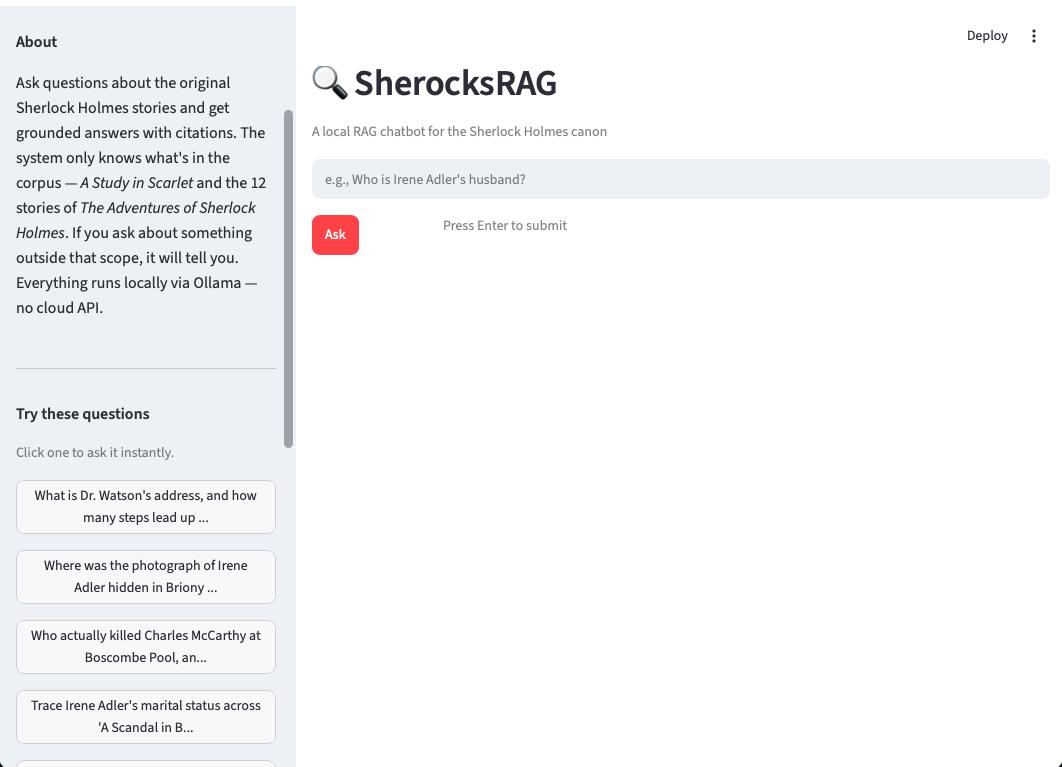
A chatbot that answers questions about the Sherlock Holmes canon — grounded only in the retrieved text, with every answer citing its sources. Built deliberately as a measured experiment: the goal was not the chatbot, but a defensible answer to “how do I know whether my RAG system is actually working — and why does it fail when it fails?”
The corpus: one novel and one short-story collection — 13 documents, ~148,000 words, all public domain. Small enough that retrieval quality can be inspected by hand, big enough that every failure mode shows up.
The problem
Section titled “The problem”Building a RAG chatbot is easy. Knowing whether it actually works is hard.
It is surprisingly easy to demo a few successful answers and conclude the system works. But a system that has not been measured is a prototype, not a solution. The questions that matter — is the evidence being retrieved? is the model answering from the evidence? is the evaluator itself trustworthy? — only get answers with a real evaluation harness.
So the experiment was designed around measurement from the start: a grounded answer format, a categorized question set, an LLM judge, and manual calibration of the judge’s verdicts.
What I built
Section titled “What I built”The agent answers only from retrieved passages, cites the specific chunk behind every claim, and refuses when the corpus doesn’t cover the question — a test of honesty, not retrieval skill.
flowchart TD
    A[Raw text files] --> B[Ingest<br/>load + normalize]
    B --> C[Chunk<br/>semantic + token-window]
    C --> D[Embed<br/>local model]
    D --> E[Store<br/>ChromaDB + metadata]
    E --> F[Retrieve<br/>query embed + top-k cosine]
    F --> G[Generate<br/>local LLM + cited context]
    G --> H[Cite + return<br/>story + chunk refs]
    J[User query] --> F
    H --> K[User answer + citations]
    K -.-> L[Eval runner<br/>30-question set + rubric<br/>LLM judge, manually calibrated]
Semantic-first chunking, token-capped with overlap. Documents split on natural boundaries first — paragraph breaks, chapter markers — then merged and trimmed to a ~400-token target with 50-token overlap. Pure fixed-window splitting would cut Holmes’s reasoning chains mid-sentence; pure paragraph splitting would produce fragments and multi-page monologues. The hybrid keeps deductions intact while staying inside a model-friendly window.
Citation-only prompting. The answer rules are strict: answer only from the provided passages, challenge a false premise when the chunks contradict it, cite every factual claim inline, and say exactly “I don’t have any source material that covers that” when nothing relevant was retrieved.
Local-first stack. Embeddings and generation both run on local models (Ollama) — no API keys, no cost, and the corpus never leaves the machine. ChromaDB for the vector store, Streamlit for the interface.
Evaluation and results
Section titled “Evaluation and results”A 30-question harness spanning four categories, each probing a different capability:
| Category | What it tests | Result |
|---|---|---|
| Factual single-hop | Answer sitting in one passage | 5/9 correct, 3 partial |
| Multi-hop | Answer requiring pieces from multiple passages | 2/6 correct, 2 partial |
| Cross-story consistency | Comparing facts across stories | 0/5 correct |
| Out-of-scope | Refusing questions the corpus doesn’t cover | 10/10 correct |
| Overall | 17/30 correct (57%), 0% hallucination |
Zero hallucination, 57% correct — and the gap between those numbers is where the findings live.
Retrieval was the dominant failure mode. Five of the six wrong answers traced to retrieval misses, not model failures: the right information existed in the corpus, but the chunk carrying it didn’t make the top-5. One question got the correct killer but the wrong weapon, because the chunk describing the actual weapon wasn’t retrieved and a pen-knife reference in another chunk was. A retrieval problem can look exactly like a generation problem until you check the evidence.
One fixed top-k doesn’t fit all questions. Cross-story consistency scored 0/5: with five retrieved chunks out of ~370, the system often received material from one story while the question needed two. Retrieval parameters should reflect question complexity.
Generation failures look different from retrieval failures. One question contained a false premise; the correct response was to challenge it. The model instead tried to satisfy the premise and produced unsupported examples. The evidence was there — the model misused it. Categorizing failures (retrieval / generation / evaluation) is what makes the next fix targeted.
Even the evaluator needs evaluation. The LLM judge misclassified one failure as a correct refusal — manual calibration caught it. A score is only as trustworthy as the methodology behind it.
What this delivers
Section titled “What this delivers”| Outcome | Evidence |
|---|---|
| Measured, not assumed | 30-question categorized harness; 0% hallucination and 57% correctness established on real runs |
| Failure modes separated and diagnosed | Retrieval vs generation vs evaluation failures identified case by case — each demands a different fix |
| Honesty under pressure | 10/10 correct refusals on out-of-scope questions — the system says “not in my source material” instead of inventing |
| A repeatable improvement loop | Hypothesis → change one variable → evaluate → inspect failures → iterate |
| Local-first, zero-cost operation | Local embedding and generation models; no API spend; corpus stays on the machine |
Why this matters
Section titled “Why this matters”The most valuable outcome wasn’t the 57% score — it was learning that hallucination was not the dominant problem. Getting the right evidence into the context in the first place was. That reframes how to improve any retrieval-based AI system: don’t start with “which model should I use?” Start with “how will I know my system is getting better?”
That discipline — build, measure, categorize failures, change one variable, measure again — is exactly what separates an AI demo from a system a team can iterate on with confidence. It is the same evaluation-first mindset behind the calibrated confidence and reconciliation gates in my other projects.